Capture new insights and boost your operational intelligence. Take advantage of powerful new technology for managing complex live systems.
What are real-time digital twins? Read the blog.

ScaleOut Digital TwinsTM* is a software framework for building and running digital twins at scale. It combines the power of digital twins with scalable, in-memory computing and AI/ML to create a breakthrough for streaming analytics and predictive modeling. Now you can track and model large systems with thousands of data sources and gain significantly better operational intelligence than previously possible. Run on-premises or in the Microsoft Azure cloud.

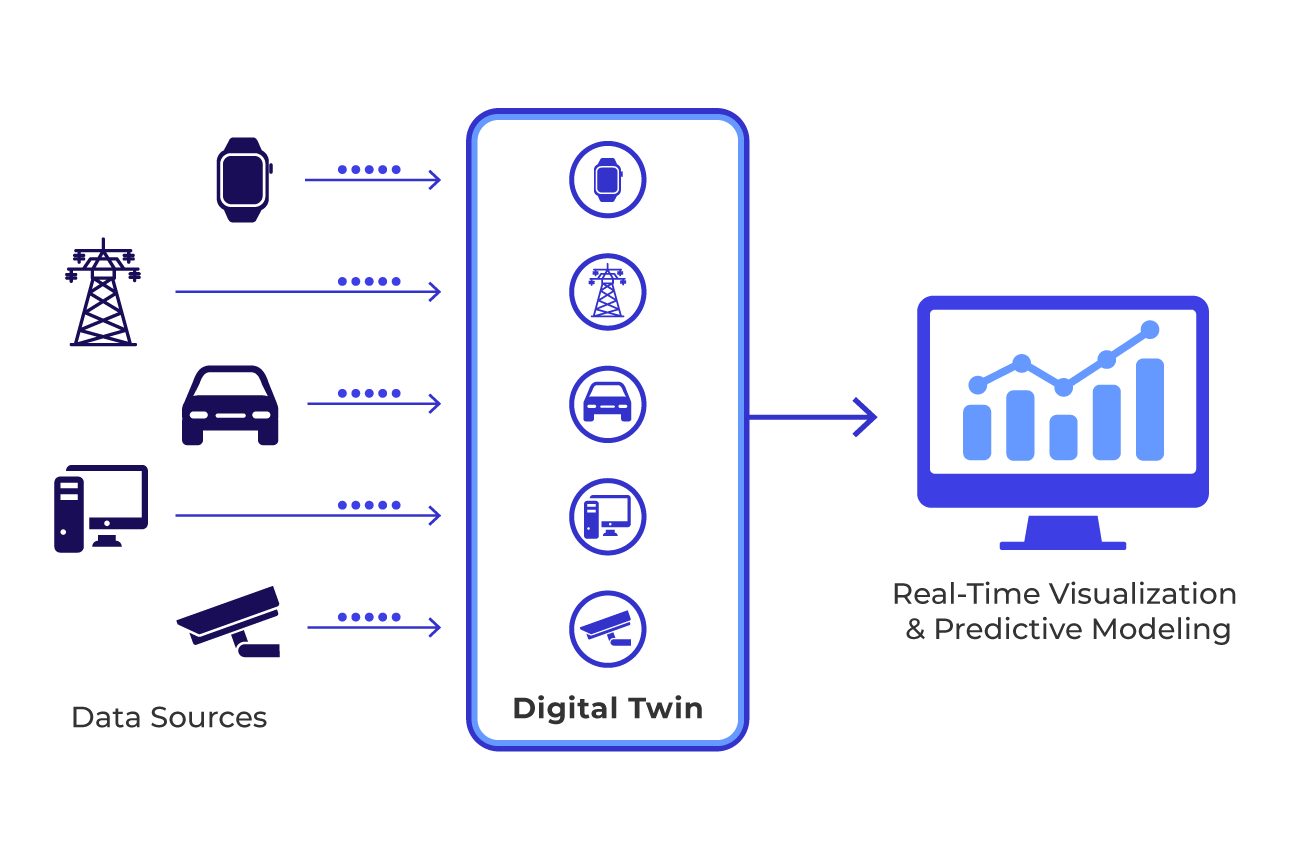
Because they maintain readily accessible contextual information about each data source and ML/AI, digital twins can quickly analyze incoming messages and run predictive models.
ScaleOut’s digital twin platform scales to track or model thousands of data sources, such as a large vehicle fleet, a distributed infrastructure, or a complex airline system.


Whether you are analyzing a nationwide telecommunications system or assisting ecommerce shoppers, ScaleOut’s digital twins can help you make better decisions in the moment.
ScaleOut uses digital twins to empower your decision making for live systems with a unique combination of predictive modeling and real-time analytics.

Ready to try ScaleOut Digital Twins? Get started for free.

By hosting digital twins on a scalable in-memory computing platform, ScaleOut make it possible to run thousands of digital twins with high performance. This platform delivers incoming messages to their digital twins within a few milliseconds for fast real-time analytics. It transparently scales using patented technology to run large simulations for predictive modeling.
Learn More
A digital twin is a virtual representation of a physical system which uses real-time and historical data to represent the state of the system. It can be used to help design, visualize, and manage a live system, and it can be used to simulate the system’s behavior.
An in-memory digital twin maintains its representation of a physical system in memory instead of in persistent storage, such as a database. By distributing the state of the digital twin across multiple servers in a cluster, an in-memory digital twin can model a very large physical system, such as a telecommunications network, and rapidly ingest telemetry. It can also provide state information to Gen AI with very low latency. ScaleOut Digital Twins™ uses in-memory computing techniques to implement digital twins.
When modeling large physical systems with thousands of components, it can be helpful to represent individual, real-world entities as software objects using object-oriented programming languages, such as Java and C#. These software objects can ingest telemetry from their corresponding physical entities and combine it with contextual information to maintain the real-time state of each entity. For example, a digital twin of a trucking fleet could represent each truck as a software object that tracks the truck’s location, speed, manifest, cargo, and mechanical condition.
By using object-oriented techniques, an in-memory digital twin can represent a very large physical system and easily distribute its digital twin objects across a cluster of servers for fast, scalable telemetry ingestion and state access. ScaleOut Digital Twins™ uses digital twin objects to implement an in-memory digital twin.
A digital twin can build a software representation of a physical system as a set of components and the relationships between them. The components represent individual real-world entities and can be implemented as software objects, called digital twin objects. The relationships between entities can be maintained in a graphical database and then realized within the digital twin as communication paths between digital twin objects.
In addition, a digital twin can maintain metadata about its overall structure, components, properties within components, and relationships between components. This metadata enables a Gen AI model to reason about the structure and state of the digital twin so that it can analyze state changes and interpret their significance.
A Gen AI model can use an in-memory digital twin to ingest both real-time data and descriptive metadata about a physical system in a process called retrieval augmented generation (RAG) so that it can reason about the state of the system. Because an in-memory digital twin maintains a representation of both the structure and state of a physical system, it enables Gen AI to more easily interpret state information and analyze the significance of state changes.
The use of in-memory computing techniques enables the digital twin to immediately deliver large volumes of state information to the AI model and eliminate bottlenecks to real-time analysis. ScaleOut Digital Twins™ connects its in-memory digital twin to Gen AI models using the industry-standard MCP protocol.
By connecting to an in-memory digital twin for RAG, a Gen AI model can immediately access the state and structure of a large, complex physical system. This enables Gen AI to reason about the evolving state of the system and identify state changes that may be of significance to system managers. These combined technologies have the potential to revolutionize real-time monitoring and improve the safety and efficiency of large systems in numerous applications, including transportation, telecommunications, manufacturing, logistics, security, disaster recovery, healthcare, and financial services.