
September 10, 2026
Version 7 adds powerful new features to the ScaleOut Product Suite and unifies management of ScaleOut Digital Twins™ and ScaleOut Active Caching™ into a single UI. Here’s a brief tour of what’s new in version 7.
Applying generative AI to live systems, for example, to monitor a telecommunications or transportation network, requires both timely information and an understanding of the system producing it. Today’s retrieval-augmented generation (RAG) relies on traditional data sources, such as databases that cannot provide live telemetry at scale, or on streaming platforms, which lack descriptive information about the system. As a result, AI lacks the continuously updated, contextualized view of a live system needed to effectively monitor and analyze it.
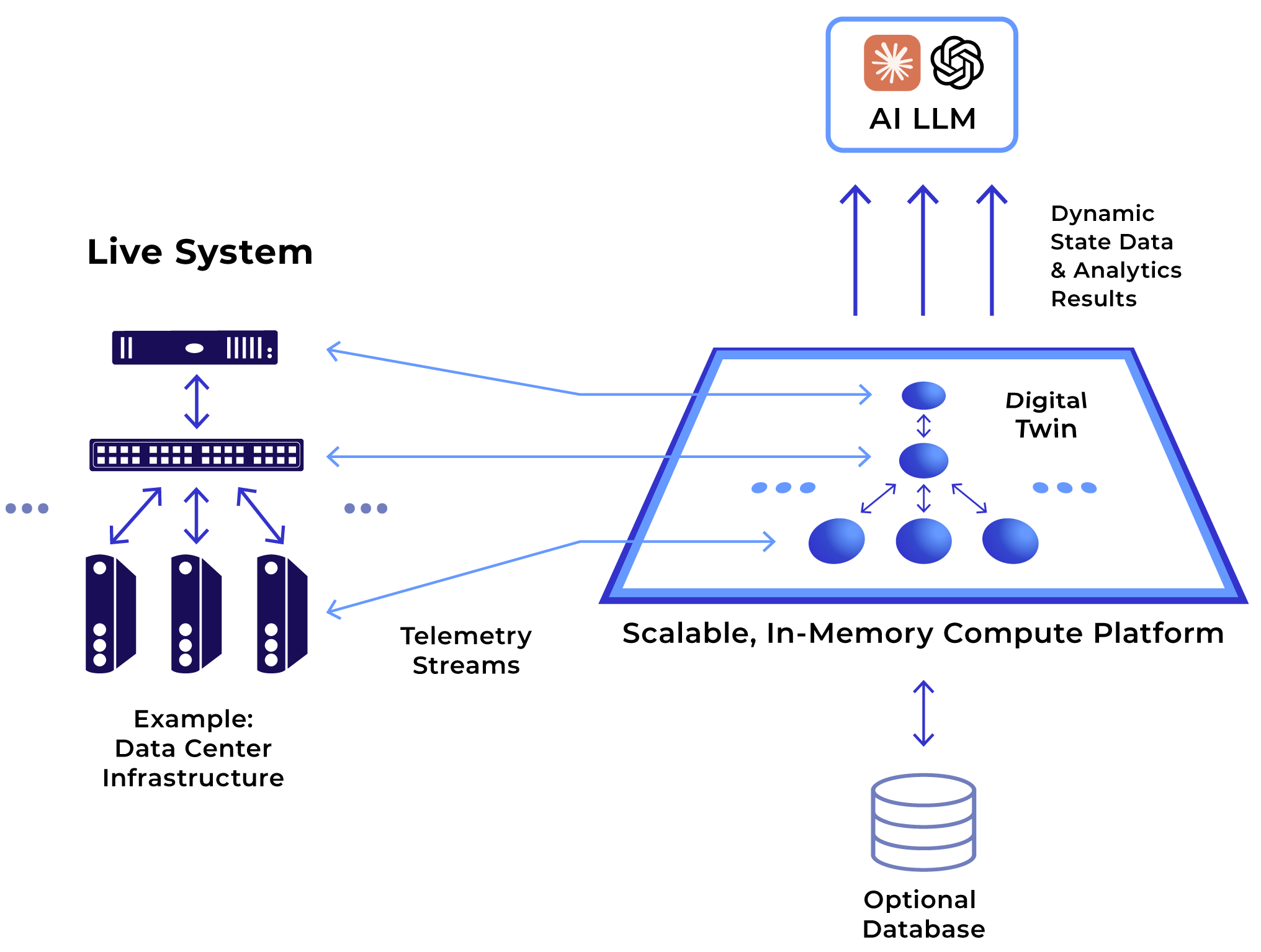
Here’s an example of an AI LLM ingesting streaming telemetry from the components of a data center, such as servers, routers, switches, racks, and power supplies. The telemetry database receives streaming data from a messaging hub like Kafka. When used to supply data to the LLM for RAG, the database creates a bottleneck to ingesting telemetry in real time, and it does not supply information about the live system’s structure:

ScaleOut Digital Twins™ addresses these issues by creating a fast, scalable data layer for AI RAG that eliminates bottlenecks in accessing live data. It uses an object-oriented, digital twin model hosted in memory to track all system components in real time. This gives AI RAG instant access to live data by interrogating component properties within the digital twin. ScaleOut hosts the in-memory digital twin on a cluster of servers and automatically scales performance as needed to match the size and complexity of a live system. This ensures that data access remains fast for very large digital twins with thousands or even millions of digital twin objects.
Starting with version 7, digital twins can also incorporate metadata that describe the overall model, individual digital twin objects, and their properties. This metadata includes details about each property’s units and expected min/max values. Rich metadata gives AI RAG deep context about the system’s structure and its intended behavior to aid its analysis.
By examining a digital twin, AI RAG has immediate access to both the state of a live system and its structure. This unique data layer enables generative AI reason about complex, live systems, identify emerging issues or opportunities, and assist personnel in managing these systems.
For example, consider the above example of using an AI LLM to ingest and analyze telemetry from a large data center. Let’s use a digital twin instead of a telemetry database to host streaming data and contextual information for RAG. The digital twin uses in-memory objects to track individual components within the data center, and it periodically receives telemetry from these components. Each digital twin object also maintains contextual information, such as model numbers, specifications, and connections to other components. Starting with version 7, each digital twin object also hosts metadata that explains the role of each component, its expected behavior, and the structure of the component hierarchy.
As illustrated below, the AI LLM can use the digital twin's scalable, in-memory compute platform to instantly access all this information and reason about health of the live system:
Version 7 now supports access to digital twin data using the industry-standard Model Context Protocol (MCP) with authentication for Claude Desktop in this release. Support for other AI models will follow in upcoming releases.
ScaleOut Active Caching™ lets developers create new data structures in Java or C# for accessing and updating cached objects within ScaleOut StateServer’s distributed cache. Deployed code can take the form of API modules, which can be invoked from client applications to access individual, cached objects, and message modules, which process incoming messages using object data. Take a look at this blog post to learn more about active caching.
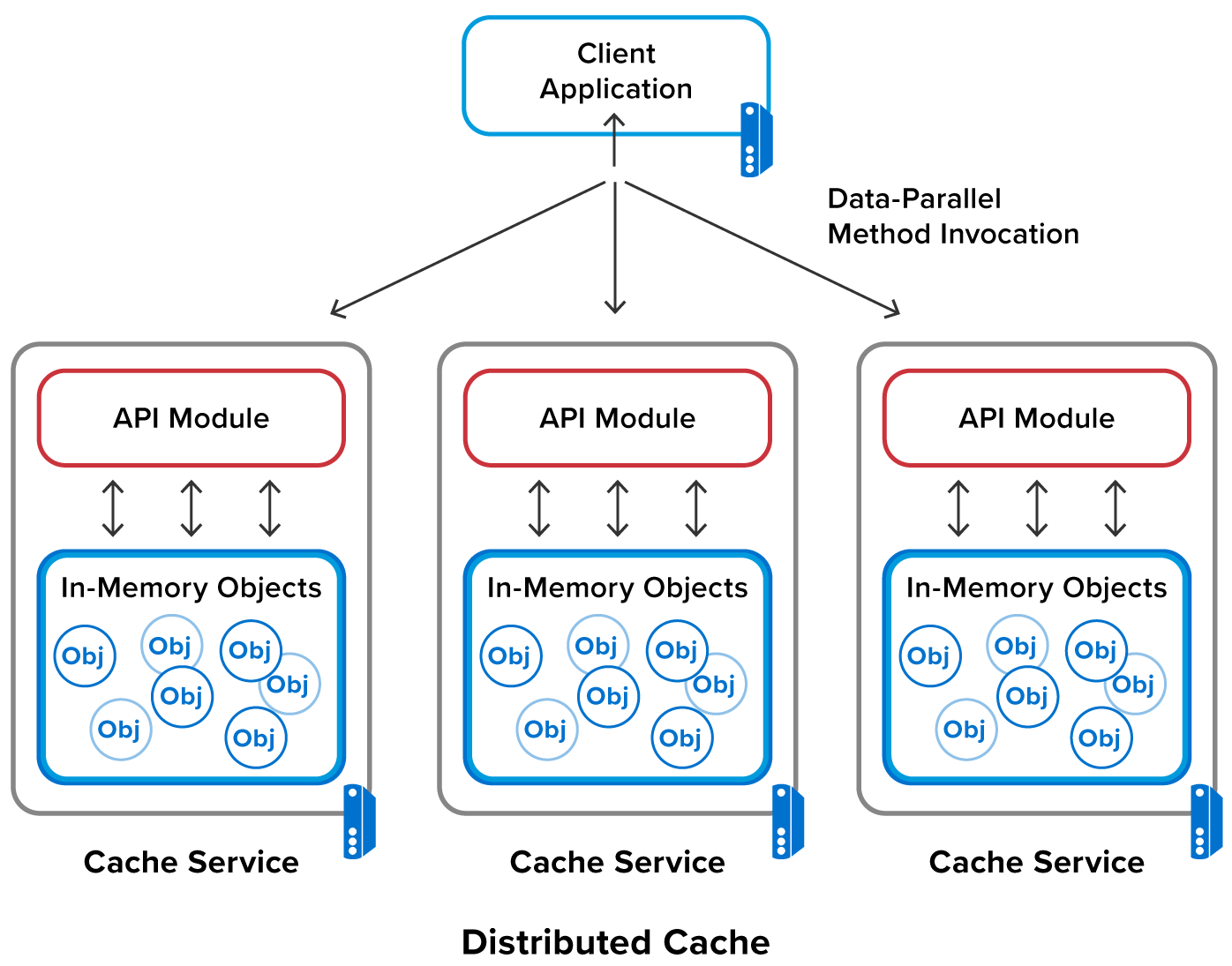
Version 7 extends API modules to invoke methods that can access all objects within a namespace as a data-parallel operation. These methods can produce results, which the module combines into a single result for return to the client. This powerful new feature lets applications analyze very large data sets with performance that automatically scales across all cache servers.
For example, a developer can implement a customized text search algorithm to scan records stored as cached objects and identify those records which meet search criteria. The developer can then easily update the search algorithm by just downloading a new version of the module to the distributed cache. Each search uses all cache servers and multiple threads on each server to run as fast as possible.
Here is an illustration of running a data-parallel operation using an API module:
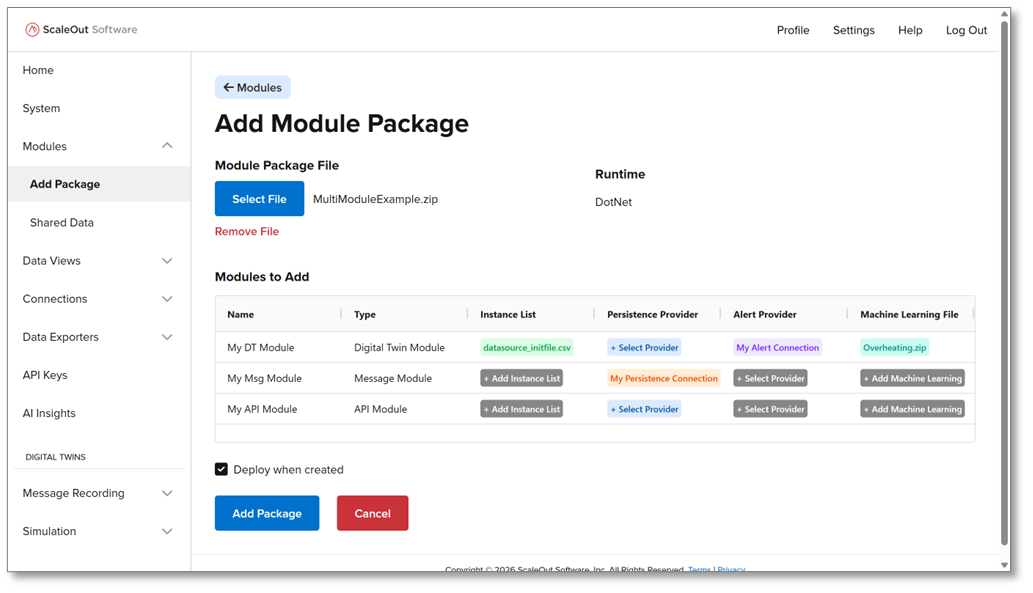
Version 7 combines the user interfaces for ScaleOut Active Caching and ScaleOut Digital Twins into a single, full integrated UI. Digital twin object models are deployed and managed identically to active caching API and message modules. Digital twin-specific features, such as simulation and message recording, are grouped together.
With version 7, users can deploy multiple modules in a single package. This minimizes the number of .NET and JVM runtimes that need to be deployed. It also accelerates digital twin simulations by reducing the number of messages that need to be sent between processes.
Here is an example screenshot of the new UI. It shows digital twin features at the bottom of the left-side navigation integrated with standard active caching features. It also shows a multi-module deployment combining three modules into one module package:

Dr. William L. Bain is the founder and CEO of ScaleOut Software, which has been developing software products since 2003 designed to enhance operational intelligence within live systems using scalable, in-memory computing technology. Bill earned a Ph.D. in electrical engineering from Rice University. With over a 40-year career focused on parallel computing, he has contributed to advancements at Bell Labs Research, Intel, and Microsoft, and holds several patents in computer architecture and distributed computing.


.jpg)